
Releasing the "Second Body"
Why had I held onto mom's Xrays and MRI CDs all these years? They were irrelevant after she died. Or were they?

Xray Vision
The side of the white plastic bag had ripped in the last 12 years, but the cotton string at the top still held. I could ease the wishing-to-disintegrate bag out from between plywood and stacked plastic bins inside my Tuff Shed. I chucked it through the door. The files landed on decomposed granite, sliding sideways and exposing “femur,” “spine,” and MRI CDs.
My mom hadn’t needed these after she died in 2014. A-hem. So, why were they still displaced inside my shed?
We had a cleanup Saturday in my nearby town. Each vehicle packed to the extreme with batteries, broken chairs or bicycles, documents to shred, electronics, or hazardous waste to be safely collected and dealt with.
On Thursday, I rifled through the slidden X-rays. Too many memories flooded. I needed to bookend. OK, where is the beginning and where is the end?
I mentally marked how incongruities exist across spectra: How mom and I had carried these data around like holy looking glasses for years and years, especially when she had a new doctor or diagnosis. They were a strange anchor in her moves as well—from her house to assisted living to a nursing care facility, then to 20+ facilities in the 8 months after the flood that contributed to her death in May 2014.
Then, overnight, they were irrelevant. What had become the difficult, painful container of her body no longer existed. We didn’t need to show evidence of multiple myeloma’s pockmarks or holes (osteolytic lesions) from head to toe or a new compression facture in her spine. We didn’t need more details about the fracture in her upper femur that doctors had placed a rod into, hoping against hope the screws holding it would stay in. We didn’t need what had become like a strange second body visioned in white and black that mirrored hers.
“F- - - You, Hierarchies”
According to the National Cancer Institute, a caregiver is “A person who gives care to people who need help taking care of themselves.”
This definition embodies an exasperating, effed-up worldview:
First, we’re supposed to be independent individuals who can “take care of ourselves.”
Second, certain people “give” care and certain people in the equation “receive” care.
Third, the one who gives care never switches to be on the receiving end of care from the other person. The phrase “a person” solidifies the identity as a noun, not a verb. It becomes an identity, a solid state. Not something fluid that shifts or morphs or reflects reciprocity.
Fourth, an inherent hierarchy within a dyad is formed. Two people are part of this dyad, but one is “above” the other person in “giving” care to the other.
Fifth, complex webs of our social worlds are erased. One person who can no longer “take care of themselves” has grown to become a dyad in which one person gives and the other receives. But as all “caregivers” know, you can’t do this alone. It truly takes a village—from doctors and nurses to pharmacists, friends, family members, people bringing spiritual care, dogs, cats, and on and on.
Hierarchies corrupt us. Doesn’t matter whether you are on “top” or on the “bottom.” The damage differs, yes, of course. But the structure itself screws us up individually and socially.
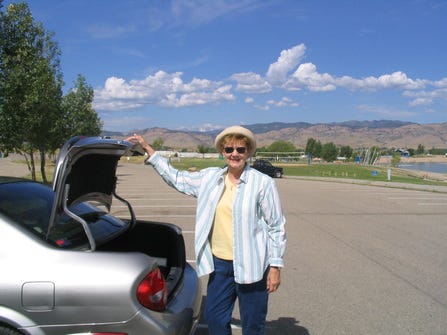
I experienced my mom as a wild black stallion! When she needed my help in the multiple myeloma journey, I wrestled with these taken-for-granted assumptions about “caregiving.” My mom was no weak, submissive woman I had to step in and take charge of. And if you forgot that fact, she’d remind you. Immediately.
She was self-possessed, fiercely independent, wise, savvy, and classy. As a seasoned counselor across decades, she’d learned to size people up within a few seconds. So, when a nurse or doctor walked in the door, they had little chance of hiding from her. She had her own Xray vision: Were they trying to dominate? Or were they “with” her in this as an equal, as part of the team?
From Caregiver to Wingmate
We fall into extremely damaging abysses when we try to reproduce hierarchies with our loved one. It may be inevitable given our cultural surrounds. But it can bring a lot of pain and suffering that needn’t be there. I learned over time that we don’t have to keep enacting these “power-over” ways of being with another person. We can have more of a “power-with” approach to care that’s empowering for all parties.
Though still not expansive enough, the term “wingmate” became my go-to description instead of “caregiver.”
In a military operation involving fighter jets, a wingmate is “the pilot of a secondary aircraft providing support or protection to a primary aircraft in a potentially dangerous situation, traditionally flying in formation to the side and slightly behind the primary craft.”
In this concept:
We have accompaniment, not a taking over and also not a distancing—being so far away you can’t see what’s threatening the leader. You do not lose the leader. You always remain with them. You are in whatever they are in.
We have flying to the side and slightly behind, NOT taking over the lead role.
We have support and care on the wing, in motion. It’s dynamic, not static—no carved-in-stone roles that do not change. Colonel Robert Smith said the wingmate watches in front while also warning the leader of threats coming from the back. They respond to the surroundings.
We have a shared sense of responsibility, yet the primary responsibility of the leader remains in their hands. No one is taking over their life or “duties” to themselves as a person. As Col. Francis "Gabby" Gabreski said, “The wingman [sic] is absolutely indispensable. I look after the wingman. The wingman looks after me. It’s another set of eyes protecting you. That’s the defensive part. … We work together. … The wingman knows what his responsibilities are and knows what mine are. Wars are not won by individuals. They’re won by teams.”
The U.S. Air Force article goes on, “One could say the acronym TEAM stands for "Together Everyone Achieves More." … Unity is the key to effectiveness: If we want the ‘more,’ then we must have the ‘together.’ Your role as a sterling wingman is vital to any level of success.”
Whether or not the militaristic context resonates, for me, the term offered a metaphor for this “new normal” my mom and I were in. It provided a visual for “being with” her—neither flying away nor taking over.
Reciprocity in Care
So, as Gabby expressed in the above quote, the lead takes care of the wingmate, and the wingmate takes care of the leader.
What might that mean in your situation?
For me, it meant the flow shouldn’t be one-sided. I should notice—and demand—my mom’s care for me.
I needed note and take stock of what I still was learning from her: what she was teaching me as we interacted with doctors, nurses, other patients, insurance staff; what life lessons she was handing down to me in weird cracks of time during a hospital-to-rehab transfer; how she was training me to advocate for (and not fight) her wild black stallion energy. And what I, spiritually, had to learn from our relationship inside the pressurized container of care, overflowing with demands, emergencies, and financial stresses.
In turn, I needed to demand she still show up as a full person, even if she had new physical disabilities. Of course, pain, treatments, and medications interfered cognitively and in other ways, sometimes for months. But when and where she was able, I needed to still treat her as someone who was “with” me, who could engage with me and give her opinions, make choices, and take action. And as my mom, someone who could consider my needs and my ways of navigating, emoting, and processing.
But ultimately, she needed to stay in the “lead.” Despite all the ways hospitals and care centers tried to infantilize her, it was her life, after all. Her choices. Her path.
Also: not mine. I was her wingmate.
So, after over a decade, hanging onto the Xrays meant I’d been there with her, a little to the side and behind. It meant I thought ahead to bring that bag of medical vision to important appointments. It meant I had protected them, then and now—and her. And she, me.
But the fight had finished. We had landed our planes side by side.
After I arced the sliced-open bag into the sharp-smelling trash compactor yesterday, my eyes flooded with tears. Another layer of grief became exposed as I let go of the “second body,” a tie, still, to her real one. Aside from her ashes, the last evidence of her flesh and bones, her body that birthed me.
It took me years to be ready to cut that tie.
But thinking of her care for me as her former wingmate, I know she’d say I also deserve self-possession, independence, and wildness. Twelve years later, I could almost hear her cheering me on.

This is a profoundly moving reflection. You perfectly capture the almost holy weight of medical records and the exhausting reality of moving a loved one through the system. :)